|
 |
Introduction to TCM

Basics of TCM
• Yin-Yang | Five Elements
Zang-Fu Theories
• Zang Organs | Fu Organs
Classification of Antineoplastic Herbal Medicines
Characteristics of Herbal Medicines
Diagnose
• By Auscultation & Olfaction
• By Inspection
Prescriptions
Theories of Channels (Meridians) and Collaterals
Reference: A Modern View of the Immune System
Differentiation of Syndromes
• 8 Principles
• 6 Channels 4 Stages
• Syndromes of Zang-Fu Organs
Etiology
• Exogenous
| Pestilential
• Pathogenic Factors
• Emotional
Materia Medica
Back to Home
|
|
Wind
Pathogenic wind prevails in spring and is a common pathogenic
factor of the common cold. It causes diseases together with other
pathogenic factors, e.g., wind-cold, wind-heat, wind-damp, etc.
Wind is a yang pathogenic factor, characterized by upward flowing
When it attacks the human body, it often affects the upper region first. For example, if exogenous pathogenic wind causes a common cold, its symptoms are headache, nasal obstruction, itching or sore throat, etc., which are confined to the upper body. If pathogenic wind together with dampness induces disease the symptoms are swelling of the eyes and face.
Wind is characterized by outward dispersion
If pathogenic wind attacks the body, it may affect the defensive qi causing derangement in the opening and closing of pores. The clinical symptoms are fever, sweating, aversion to wind, etc.
Wind blows in gusts and is characterized by rapid change
In the Suwen it says, "The wind is good at traveling and undergoes change frequently." Diseases caused by wind are marked by migrating disease location and symptoms that appear and disappear. Onset is abrupt and disappearance hasty, e.g., migrating joint pain of bi syndromes, which usually involve joint pains, and intolerable itching of urticaria.
Wind is characterized by constant moving
Pathogenic wind causes motor impairment or abnormal motion of the trunk or limbs manifested by convulsion, opisthotonos, spasm and tremor of the four limbs, and rigidity of the neck. In the Suwen it says, "Predominant wind causes symptoms characterized by movements."
Wind is liable to associate itself with other pathogenic factors
Pathogenic wind is apt to be accompanied with cold, damp, or heat to become wind-cold, wind-damp, or wind-heat pathogenic factors.
Wind may be also associated with some pathological products such
as phlegm, forming pathogenic wind-phlegm. The commonly seen symptoms
caused by exogenous pathogenic wind are known as shangfeng (wind damage).
Main clinical manifestations: fever, aversion to wind, perspiration,
slow and superficial pulse, dry and itching throat, cough, nasal
obstruction and discharge.
These symptoms are due to damage by exogenous pathogenic wind to
the body surface and the lung. If exogenous pathogenic wind attacks
the skin and muscles, the wei (defensive) qi is damaged and fails to
defend the body surface. So perspiration and aversion to wind occur.
When wei qi fights against exogenous pathogenic wind, fever arises.
When the disease locates in the exterior of the body, it causes sweating,
thus the pulse is superficial and slow. When exogenous pathogenic wind
attacks the lung, its function will become abnormal in the spreading and
descending of qi and also brings about a dysfunction of body fluid
distribution. The clinical manifestations of dry and itching throat,
cough, nasal obstruction and discharge occur.
More about the other Exogenous Factors:
Cold,
Summer-heat,
Damp,
Dryness,
Fire Heat and Mild Heat.
|

|
|
|
|
|
|
|
|
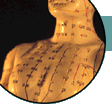
WHAT IS TRADITIONAL CHINESE MEDICINE?

Photo © Image DJ Image Dictionary
With over 3000 years of experience, Traditional Chinese Medicine (TCM) has
remain one of the many fascinating areas in ancient Chinese culture.
First known to be documented in the Yellow Emperor's Canon of Medicine,
TCM is believed to have been practised in as early as 475 to 221 B.C.
The field of working knowledge of TCM stretches from anything related to
general healthcare practice to the philosophy of the mind, the logic of life,
religion, and even to as far as cosmology and astronumerology. This is why
in order to thoroughly understand the concepts behind TCM, one must be
comprehensive in learning and embracing the Chinese culture as a whole.
Just as Douglas Hoff put it when he explained about accupuncture, "The systems
of TCM uses the concepts of elements and meridians and are completely immersed
in the Asian cosmology which takes shape through the religions." The meridian-brain mechanism,
the fundamental working concept of acupuncture, in which the pain block from the message
that the needle or burning cone of herbs gives to the point of stimulus,
was only found centuries later by the West through science and technology.
|
| |
|
MESSAGE FROM THE EDITOR – MARCH 2020
 Thank you for visiting this TCM and acupuncture information website.
If you have previously been to this website, you might have
noticed that some of the pages on ancient historical ideas and
holistic thinkings related to Chinese metaphysics are temporarily taken offline.
This is because I will be revamping the whole website and be moving
those information into a new \"Ancient Chinese Culture\" section
so as to reflect a more current perspective on the interpretation
of some of the fundamental concepts as well as to include
some of the latest information in the area.
But if you have just found this website for the very first time, I welcome you again and
wish you could find what you require and, hopefully, you could also be benefitted
from reading the articles I published on this website.
Thank you for visiting this TCM and acupuncture information website.
If you have previously been to this website, you might have
noticed that some of the pages on ancient historical ideas and
holistic thinkings related to Chinese metaphysics are temporarily taken offline.
This is because I will be revamping the whole website and be moving
those information into a new \"Ancient Chinese Culture\" section
so as to reflect a more current perspective on the interpretation
of some of the fundamental concepts as well as to include
some of the latest information in the area.
But if you have just found this website for the very first time, I welcome you again and
wish you could find what you require and, hopefully, you could also be benefitted
from reading the articles I published on this website.
Please be patient and do come and check out this website frequently as it's being revamped.
Raymond Cheng, PhD DPA FRSA FRSPH
March 28, 2020.
|
|
|
IMPORTANT NOTICE AND DISCLAIMER
 This website is published, edited and designed by Raymond Cheng,
and reflects only and only his personal views and opinions in his individual capacity.
The information available at this website is not intended
directly or by implication to either diagnose or treat any
medical, emotional, or psychological condition or disorder.
It is also not intended to create a physician-patient relationship
between you and I or between you and Wyith Institute™ and The Office of Dr Raymond K K Cheng.
The information here is not a substitute for advice and treatment provided
by your physician or by another healthcare professional.
It is always recommended that consultation with local healthcare providers
be obtained for any of your specific health or medical concerns.
Furthermore, any products that can be purchased (yet you can see I don't have much
to sell here) through advertisers' banners or through links to other websites
are not either explicitly or implicitly given any warranty or endorsement
by me, my colleagues, Wyith Institute™ or any of its associated businesses.
This website is published, edited and designed by Raymond Cheng,
and reflects only and only his personal views and opinions in his individual capacity.
The information available at this website is not intended
directly or by implication to either diagnose or treat any
medical, emotional, or psychological condition or disorder.
It is also not intended to create a physician-patient relationship
between you and I or between you and Wyith Institute™ and The Office of Dr Raymond K K Cheng.
The information here is not a substitute for advice and treatment provided
by your physician or by another healthcare professional.
It is always recommended that consultation with local healthcare providers
be obtained for any of your specific health or medical concerns.
Furthermore, any products that can be purchased (yet you can see I don't have much
to sell here) through advertisers' banners or through links to other websites
are not either explicitly or implicitly given any warranty or endorsement
by me, my colleagues, Wyith Institute™ or any of its associated businesses.
|
|
|
|